2025 Association Update
A version of this report was presented to those who attended the conference, in person and online, on June 19 during the Business Meeting. This report expands upon the Association Update presentation (Kutsko 2025c).
A main feature of my report is to present to members the state of Atla’s finances at the last fiscal year’s audit, that is, the year ending nine months ago, August 31, 2024. I also provide program and product highlights since last June, and we look ahead to next year’s initiatives. I say each year that there is no way to adequately convey the business details, the development of the databases, the Open Press publishing, and association programs and services in the few minutes I have during Atla Annual. Neither can I do that in this report. And, honestly, we hear from you in surveys that you can’t keep up—you’re not aware of all we do. To be sure, we have to better communicate the 24/7 programs and services for you and your institutions in addition to the Annual Reports, blogs, social media, and announcements posted to Atla.com—and we will.
In addition to these typical updates, I want to provide what I believe is a frank look at our challenges ahead, because that may not be evident in an annual snapshot or in a financially positive year, such as this one. It is easy to look past challenges, to mention only vaguely the disruptions happening in higher education and theological education. I want to be blunt and tell you what keeps me up at night.
FINANCIAL UPDATE
FY2025
The last fiscal year that ended August 31, 2024, was financially positive, and the state of the association is strong. The audited fiscal year’s financial statements from the independent audit are available online in the 2024 Annual Report on pages 31-50 (Atla n.d.). All our audit reports and Annual Reports are now publicly available on Atla.com. The paragraphs below reference those pages.
The audited Statement of Financial Position reported the organization’s total liabilities and net assets at year-end, August 31, 2024, as $21,907,211. This was up $2,564,348 from FY2023. Actual revenue was $9,318,901 (excluding foundation restricted funds of $973,439) against actual expenses of $7,891,692, as shown on the Statement of Activities. This brings Atla’s total net assets (sometimes called total net worth) to $14,870,395, up $2,400,648 from FY2023. It was a positive fiscal year from FY2023 to FY2024.
Current assets represent cash and investments and other assets that will likely be converted to, or provide benefit similar to, cash in the next 12 months. The current asset level is a gauge of liquidity and the organization’s ability to meet its near-term obligations. Atla’s current assets increased by $2,233,919 from FY2023 to FY2024 showing that Atla continues to have strong coverage to support its liabilities.
The unaudited FY2025 Q2 financials (this year) show that current assets total $11,590,051, which is an increase of $1,177,228 over the previous year. This continues our good cash flow position this year.
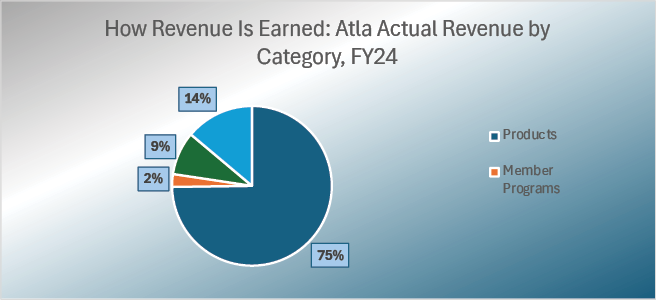
Atla’s primary source of revenue (75%) continues to be royalties from the research tools we create: RDB, Atlas, and AtlasPLUS. Income generated from Member Programs activities (2%) include dues, conference fees, and fees for services such as hosting e-journals for other organizations. Administration is a category that includes unrealized gains and losses from investments, and we’ve had gains this year. In addition, Atla received over $900,000 related to grants from foundations that represented 9% of overall revenues.
On the expense side, the largest portion (53%) was used to produce the Atla research databases we create and provide through EBSCO. However, a significant amount of Atla’s expenses—approximately ten times the revenue—is focused on fulfilling the mission of the association. Last year this was 20%, which is also higher than the previous year. This includes funding committee work, open-access publishing, Member Programs staff, and professional development opportunities for our members, such as Atla Annual and our webinar series. Board and governance work, as well as much of the administration costs, are also really the work of Atla’s Organizational Ends.
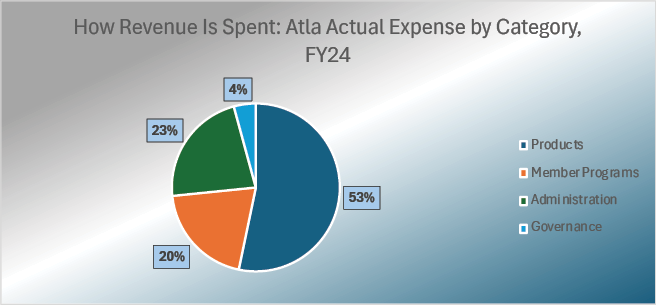
These two pie charts—how revenue is earned and how revenue is spent—are critical to appreciate. They demonstrate the role Atla databases play in revenue for the association. However, they also reveal how the databases represent Atla’s contribution to information literacy in religion and theology, core to what theological librarianship represents, fosters, and promotes. Please support the use of the databases at your institutions.
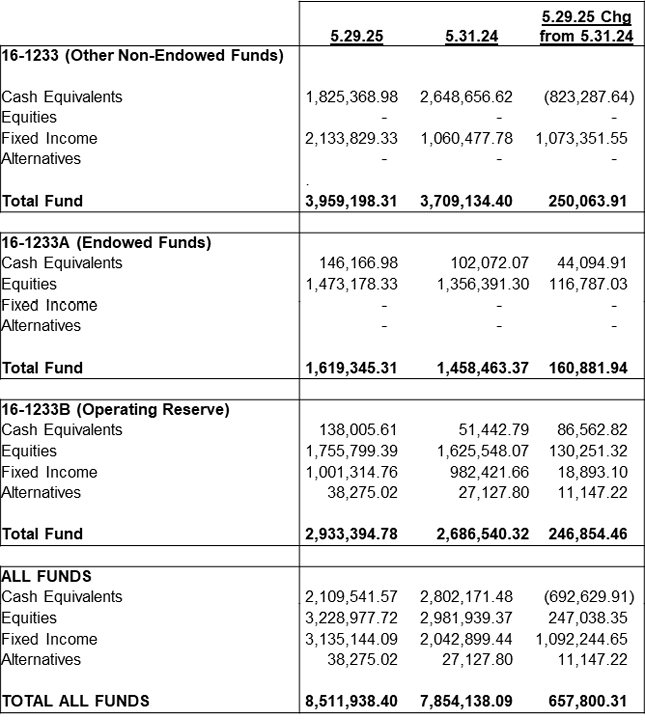
Below is a year-to-year comparison of investment. Total investments including the Endowment, Operating Reserve, and other non-endowed funds grew from $7,854,138 in May 2024 to $8,511,938 by May 2025, which is over $657,000 greater. This growth is largely due to increases in market valuation of the holdings and realized investment income. The allocations allowed now by the investment policy have significantly helped over the last two years.
Table 1: Total Investments
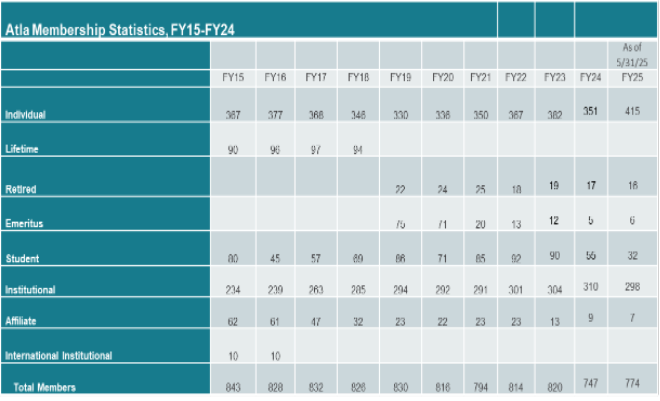
As of May 31, Atla has 774 members in 20 different countries. From May 2024 to May 2025, Membership is up in the individual category and in most other categories. Membership bundling, with the help of our institutional members, has been a success. With more individuals as members, there is a larger number of individuals eligible to participate in the governance of the association, serving on Committees and on the Board. It also allows Atla to have a direct line of communication to those individuals instead of the member representative being responsible for sharing news about programming, professional development, individual grants, and events. Bundling, however, does not significantly increase revenue. That wasn’t its goal.
Table 2: Atla Membership Trends
Budgeting and Planning for FY2026 and Beyond
The next two charts provide a longitudinal view of three important association metrics since FY2017.
- Atla’s total net assets, and you can see a healthy rise here.
- The Atla Endowment, and here, too, you see a steady rise.
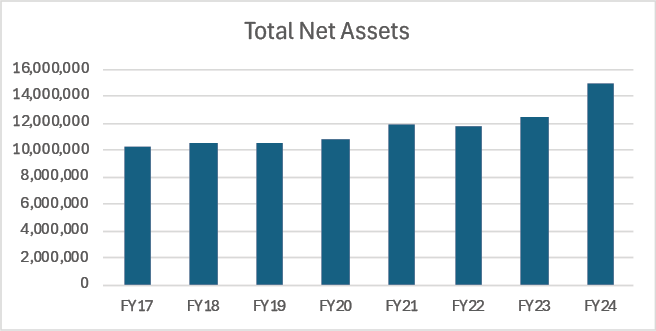
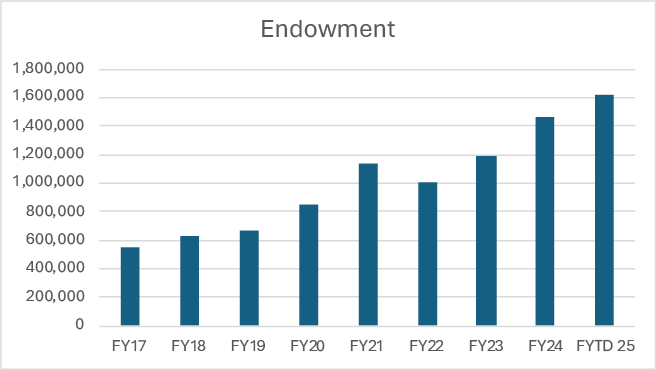
These trends might suggest all is well, but the trends hide some realities. I know, you’re saying to yourself, here goes Kutsko focusing on the negative. Yes, Atla’s assets have increased more than $3 million in two years, but the leadership team and I soberly look at cash and subtract out things like unrealized market gains, unexpected bequests, and one-time grants. We are delighted to have raised $900,000 last year, most of it from the Lilly Endowment to support Project Eureka, and money to support the exploration for a new database for religion and professions (Atla 2024). However, we can’t build long-term expense structures with those funds because they are designated and restricted. Not only is the market this year exceptionally volatile, but what goes up sometimes goes down. Atla also treats its databases as intangible assets, which they are, but I focus on the word intangible, not the word asset. For example, each year we capitalize production costs and amortize them over ten years, with the current year going in at a higher inflationary amount than the decade-old year’s amount going out, which increases Atla’s net assets every year without actually being tangible. So, when the Atla leadership team budgets, we focus on cash assets and adjust out capitalization, one-time grants and bequests, unrealized market gains, and intangible assets. We treat these as unusual and unreliable.
It is important we do that especially for next year. We are facing a year in which we cannot see around the corner. Higher education in the US is rapidly being reinvented and reprioritized. Theological education, like congregations, has declined over two decades, and we are likely to see that amount of change in just the next two years, not twenty.
Henry Ford famously said, “If I had asked my customers what they wanted, they would have said a faster horse.” Ford’s faster horse fallacy highlights how people tend to want a better version of the past and base their desire on current limitations and not a new paradigm. But innovations like the iPhone and Uber arose from addressing unmet needs rather than directly responding to customer requests for “a better version” of what exists. AI, for example, is a new paradigm, and even its programmers admit to not fully understanding it. Incidentally, this is also why Atla is taking a leadership role with ATS and In Trust to understand the opportunities for its members and their institutions.
Like Ford, when we ask Atla members what they want, we hear something like, “1975.” But it’s 2025, and we can’t go back. We’re going to face very challenging times, including budgeting for next year, caused by enrollment decline, loss of billions of dollars in federal research funding and student aid, sweeping cuts to agencies like the IMLS, leading to institutional austerity, and faculty and library job loss. So, we, too, must seriously consider hard decisions and significant changes. With hard decisions, we will inevitably have sacred cows that won’t make it.
And even when change is positive, it elicits two powerful emotions: nostalgia and fear. And the closest cousins of nostalgia and fear are sadness and anger. These are real organizational emotions. I hope you read Susan Ebertz’s last blog as board president—it was on nostalgia (Ebertz 2025). I’ll write more about that emotion in September, when we begin a new fiscal year.
To adapt and evolve, we may want to consider ways to expand and broaden our mission and increase our organization’s visibility. This will help us to promote theological librarianship, to look for opportunities for new library services, to consider new ways to convene at Atla Annual, to create new products that showcase the breadth of skills theological librarians have, and to serve the wide range of jobs that religion and theology inform.
You’ve heard me say that religion is everywhere. When other professions, not just other academic disciplines, need to understand religion and theology, you will be the guides. I wrote to you in May that the technology term “interoperability” captures the extraordinary skill set and knowledge base of theological librarianship (Kutsko 2025b). Your value to the seminary and university lies in your unique ability to connect people, disciplines, and resources. In our increasingly utilitarian academic environment, theological librarians serve as interdisciplinary mediators, translators, and facilitators. I wrote to you in March that Atla’s past, present, and future is a path toward new associations, connections, and collaborations in widening circles that demonstrate and showcase the critical role of theological librarianship in society (Kutsko 2025a). I believe that. I hope you believe that. I hope, together, we can embrace that.
Programs and Services Update
Project Eureka
Last year at this time, we announced that Atla received a grant to build a federated search solution to support research, teaching, and ministry (Atla 2024). The first of its kind for theological education, this centralized hub will be an open discovery platform that cross-searches a wide range of materials, including a significant number of open access resources, special archives and collections, and institutional histories. It will be designed to serve and support theological education, interdisciplinary research in religion, preaching, and teaching. It is being designed to reach well beyond institutions and those at them to be accessible to individuals. While religion is everywhere, Atla is the theological library association that connects people and resources so that everyone can better understand religion and theology.
At the start of this year, supported by funding from the Lilly grant, we officially began building the beta version of Project Eureka, which is scheduled for completion by August 2025. This milestone aligns with the project’s goals and marks a significant step in fulfilling our grant commitment to Lilly, as the beta site is designed to serve as proof of concept for the project’s innovative approach. The beta will provide a collaborative springboard to attract and engage new community content partners, organizations, and archives. We will also use the beta to gather feedback from the community to guide features, content, and marketing development in support of the full release in Summer 2026.
Atla Religion Database (Atla RDB)
In the midst of that major product development, the production team has also reached a major milestone with the current databases. As of June, RDB now exceeds four million records, with over 2,780 serial titles, of which more than 1,400 are actively indexed. To give this pace of growth some context, it took ten years to grow from two million to three million records and less than five years to grow from three million to four. RDB began as a crowd-sourced database in 1950 (the Religion Index). It has grown in diversity and breadth, and is without peer.
I am also pleased to share key updates from Atla’s editorial team as we expand RDB to meet the research community’s evolving needs. We continue to broaden our coverage across disciplines—emphasizing the role of religion in society and helping researchers better understand its intersection with social, cultural, and political dynamics worldwide.
Our content strategy enhances the study of Religion and Society, focusing on journals that offer unique voices and geographic perspectives. Recent additions highlight religion’s connections with business, politics, ethics, and culture, encouraging interdisciplinary collaboration and enriching our members’ access to diverse, global scholarship. Notably, these new titles are already experiencing high usage, reflecting strong interest and engagement from our research community.
Atlas and Atlas PLUS
Atlas currently offers 415 titles. Atlas PLUS includes 750 titles. Eighty-five percent of these titles have coverage starting from volume one, issue one.
These newly added full-text titles reflect our ongoing commitment to advancing the study of religion and society. By including journals such as the Journal of Religion and Demography, Decisions of the Roman Rota, and the International Journal of Sport and Religion, along with expanded relationships with leading publishers and organizations, we ensure our collection represents a broad spectrum of perspectives and scholarship. This approach supports our mission to provide comprehensive resources that illuminate the diverse ways religion shapes and interacts with communities and cultures worldwide.
Membership
As mentioned earlier, Membership Bundling has increased individual membership and offered new opportunities. In FY2025, staff made a concerted effort to promote and assist institutional members in bundling memberships, which has had the desired effect of increasing the number of individual memberships. As of April 2025, 196 institutions (65% of all institutional members) utilized membership bundling. Of the 301 individual members that were part of a bundle, 140 (46.5%) were new joins.
The majority of institutions using bundling assigned one individual membership, several assigned and paid for one or two additional individual members, and a handful of institutions assigned and paid for three or more memberships, with one institutional member assigning and paying for ten additional memberships. Thank you to the institutional representatives who see the value Atla membership provides their staff and, through them, their institution’s faculty and students.
Atla Annual 2025
Atla Annual 2025 provides opportunities for education and networking with the feel of a family reunion. Registration for this year’s Atla Annual was slightly less than the previous year. However, this is the first year since the pandemic that the number of in person to online attendees hasn’t been close to 50/50. This year, 72% registered to attend in person. An even higher percentage of first-time attendees, 83%, registered to attend in person.
The number of concurrent sessions this year decreased as well, and fewer proposals were received than in previous years. The number of exhibitors was comparable to previous post-pandemic years, but the number was still significantly lower than pre-pandemic levels. The timely programming included sessions focused on AI, leadership, the theological education environment in North America and globally, digitizing and working with primary source materials, reference and information literacy, and more.
Marketing and Promotion
The Membership and Engagement team works across the organization to promote and market Atla programs and resources. Building on the success of last year, this year we have continued to work closely with EBSCO on several marketing campaigns to drive awareness of the Atla databases, increase use, and demonstrate the value of the databases in student learning and outcomes. If you haven’t watched the interview with Dr. Samual Adams (Chair of Biblical Studies at Union Theological Seminary), I encourage you to do so and to share it with your students and faculty (Atla 2025).
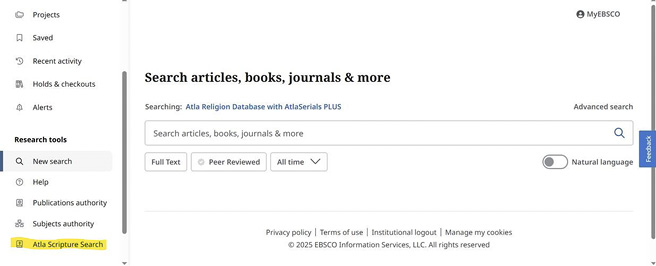
We also worked closely with EBSCO to add a link to the “Atla Scripture Search” under the “Research Tools” section of the new EBSCO UI, addressing a concern of many members and clearing the way for them to transition (Cain 2025).
In addition to the regular monthly title updates, we have started focusing on marketing specific content in the databases by title or publisher, or by subject area or focus. These content marketing pieces are designed to not only create awareness of new and interesting content, but also to help librarians alert their faculty to content in the databases that align with their interest, research areas, or course curriculum. Please share these, too, with your institutional colleagues.
AI Leadership
In a March 2024 blog post, I promised that “Atla’s leadership in how AI can be used to study our past, serve the present, and protect the future will be critical in a world in which religion is everywhere” (Kutsko, 2024). For the past year, Atla has been collaborating with ATS and In Trust to offer several professional development and education opportunities relating to AI and theological education. Events included several seminars and the creation of a microcredential (short course) that was first offered this spring. Response to the material and this collaboration has been extraordinarily positive and we hope to continue this collaboration next year. We feel it is critically important for Atla to collaborate with others in the ecosystem on this effort. While AI is not limited to the library sphere, this is an area where librarians can take on a leadership role to educate and implement AI within their institutional context.
Surveys
The Membership and Engagement team has also spent a major portion of its capacity to develop two types of surveys to better understand what you face and experience and what we face in theological librarianship with our peers worldwide. We launched these surveys last year and are routinizing them this year and next.
One type is an annual membership satisfaction survey, split into three parts this year. It asks you how Atla is doing with its products, services, and advocacy. These surveys, while designed to help measure and report progress toward the Organizational Ends, also provided invaluable insight into the current state of Atla member libraries, and the report being finalized is designed to help those in research, teaching and learning, and administration better understand librarians and their work.
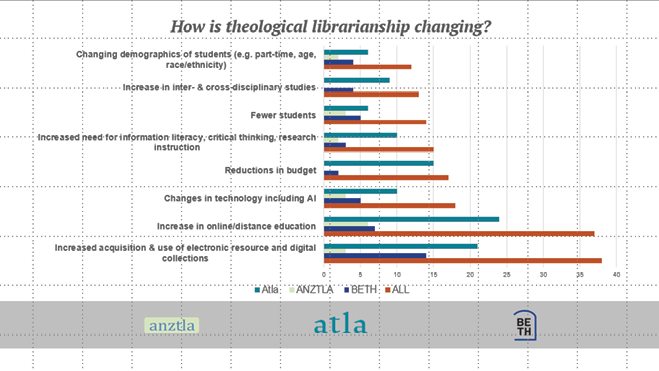
A second type of survey, which will be distributed every other year, is an International Demographic and Environment Global Study conducted in collaboration with BETH, ANZTLA, and ABTAPL, and distributed in three languages. This study is designed to understand the environment in which theological and religious studies libraries are functioning, and how libraries and librarianship are evolving to meet the changing landscape of theological education. The results of the 2024 study will soon be released to members, peer associations and societies, stakeholders, and decision-makers in theological education to help foster dialogue about the future of theological libraries.
***
Like you, with your interoperable skills, on the threshold of Atla’s 80th anniversary, Atla asks itself, where can we, where should we, where do we go from here? Where and what do you want your association to be? We are listening.
References
Atla. 2024. “Atla Awarded Lilly Endowment Grant for Discovery Platform Serving the Study of Religion and Theology Worldwide.” Press release, July 30. https://www.atla.com/blog/atla-awarded-lilly-endowment-grant-for-discovery-platform-serving-the-study-of-religion-and-theology-worldwide/.
Atla. 2025. “Conversations with Atla: Dr. Samuel Adams of Union Presbyterian Seminary.” Atla Blog, June 10. https://www.atla.com/blog/conversations-with-atla-dr-samuel-adams-of-union-presbyterian-seminary/.
Atla. n.d. “Atla Annual Report.” https://www.atla.com/about/annual-report/.
Ebertz, Susan. 2025. “The Paradox of Nostalgia and Change.” Atla Blog, June 9. https://www.atla.com/blog/the-paradox-of-nostalgia-and-change/.
Cain, Gillian Harrison. 2025. “Atla Scripture Search in New EBSCO UI.” Atla Blog, April 10. https://www.atla.com/blog/atla-scripture-search-in-new-ebsco-ui/.
Kutsko, John. 2024. “To Serve, Preserve, and Protect.” Atla Blog, March 5. https://www.atla.com/blog/to-serve-preserve-and-protect/.
Kutsko, John. 2025a. “Atla’s Associations: Community and Collaboration.” Atla Blog, March 11. https://www.atla.com/blog/atlas-associations-community-and-collaboration/.
Kutsko, John. 2025b. “The Interoperability of Theological Librarians.” Atla Blog, May 12. https://www.atla.com/blog/the-interoperability-of-theological-librarians/.
Kutsko, John. 2025c. “Atla 2024-2025 Association Update.” Atla Blog, July 8. https://www.atla.com/blog/atla-2024-2025-association-update/.